How hospitals are implementing AI into their daily operations
Healthcare AI is exploding—from $39.3B to a projected $504.2B by 2032. Healthcare Brew explores how Cleveland Clinic, Mayo Clinic, and Epic are betting on AI, the trust gaps holding clinicians back, and what it takes to get adoption right.
Healthcare has never been great at moving quickly. Then AI showed up.
In the span of a year, the technology went from boardroom conversation to bedside reality—and the numbers back it up. The healthcare AI market is valued at $39.3 billion in 2025 and is projected to hit $504.2 billion by 2032. Hospitals are deploying it to predict sepsis before it strikes, automate the back office, and shave 14 minutes off a clinician’s daily documentation burden. That last one doesn’t sound like much until you multiply it by 20,000 nurses.
But the rollout isn’t clean.
The same week a Johns Hopkins study found that doctors using AI for clinical decisions are viewed skeptically by their own peers, Mayo Clinic researchers published work showing that algorithms can predict drug efficacy with 89% accuracy—potentially reshaping how clinical trials get designed. Cleveland Clinic is co-building AI tools from scratch with startups. Epic, the EHR giant with records for 325 million patients, just launched its own AI scribe. And predictive AI adoption in hospitals jumped from 66% to 71% in a single year.
The technology is real. The adoption is uneven. The stakes—safer, more affordable, more scalable care—couldn’t be higher.
What’s Inside
Table of Contents
Chapter One
Cleveland Clinic’s AI strategy includes building the tools from the ground up
Chapter Three
How Mayo Clinic researchers are using algorithms to predict drug efficacy
Chapter Four
Doctors using AI for clinical decision-making viewed negatively by peers, study finds
Chapter Five
How the AI scribe market may—or may not—shift following Epic’s AI tool launch
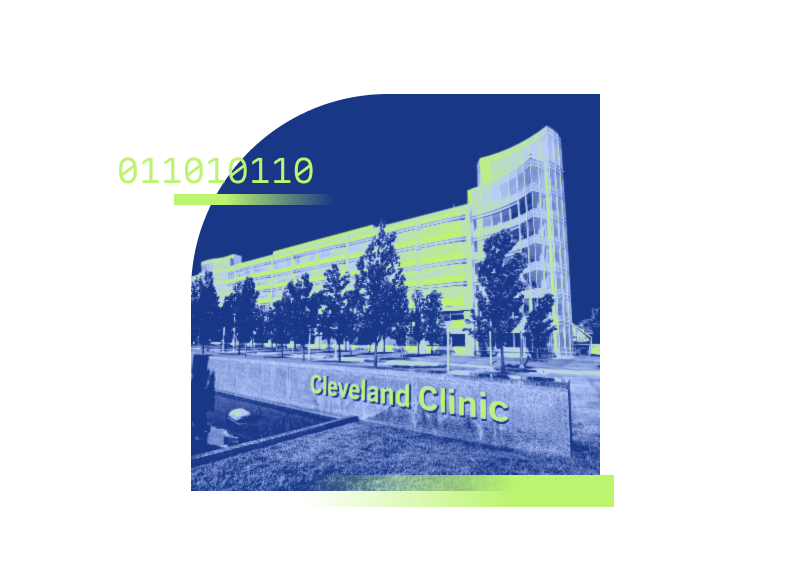
Cleveland Clinic has teamed up with Ambience, Akasa, Bayesian, and IBM.
While some hospitals are strategically buying AI products from health techs, Cleveland Clinic is taking a different approach: working with startups and established tech companies from the beginning.
This year alone, the health system has teamed up with Ambience Healthcare for an AI scribe, Akasa for coding and revenue cycle management, and Bayesian Health for sepsis detection. It’s also been partnering with IBM to create a quantum computing system for clinical research since 2023.
AI is a quickly growing sector in the healthcare industry, valued at $39.3 billion in 2025 and projected to reach $504.2 billion by 2032, according to Fortune Business Insights. Tools are used for everything from clinical documentation to call intake to diagnosis insights.
Venture fund Rock Health reported in July that AI made up the majority (62%, or nearly $4 billion) of venture capital (VC) dollars for the digital health sector in the first half of 2025.
Other major providers have also joined forces with AI tech companies—like Rochester, Minnesota-based Mayo Clinic and telehealth platform hellocare.ai as well as Chicago-based Northwestern Medicine and pathology diagnostics platform PathAI—creating a level of shared knowledge across health systems on which tools are the most beneficial.
Why this approach?
Rohit Chandra, chief digital officer at Cleveland Clinic, outlined three reasons why the Clinic took the partnership approach to AI.
First, he said, “we’re a healthcare company, not a technology company” that benefits from sharing the expertise and potential to expand products in the long term.
Second, he said, AI is still in its “early stages.” Cleveland Clinic wants to use “transformative” technology, but knows it could take years for a finished product to show up on the market.
“We’re willing to learn how to use these technologies, learn how to bend them to our environment,” Chandra said.
Last, he said the healthcare industry is “ripe for AI power transformation,” and therefore Cleveland Clinic wants to “take a big swing” at defining the future of the industry.
What does the partnership look like?
Chandra said Cleveland Clinic looks for companies with a similar ambition and those that are a good “cultural” fit.
Ambience, for example, wanted to be more than just an AI scribe from the beginning, and that stood out to the Cclinic, Chandra said. Ambience is one of the leading players in the AI scribe market, according to an October report from VC firm Menlo Ventures, and has other partners including Houston Methodist, Idaho-based St. Luke’s Health System, and UCSF Health.
More than 4,000 clinicians at Cleveland Clinic participated in the pilot rollout of Ambience, which was used in 1 million patient encounters and reduced clinicians’ time writing and reviewing electronic medical records by 14 minutes each day, according to internal research.
Functionally, the partnership includes identifying a problem, like how to improve clinical outcomes or implement automation. Then the codevelopment and codesign kicks off, Chandra said.
With Ambience, people from both organizations sat down together and planned out which physicians would test out the technology first to get feedback before sending the tech out to the wider staff.
It isn’t just about how the tech works, Chandra added, because you need to get clinicians to adopt and use it at scale.
“Which means you need to be very thoughtful about change management because if you’re going to change the behavior of 20,000 nurses, you need to design the heck out of it,” he said.
Business benefits
Megan Zweig, president and CEO of the Rock Health Advisory consulting group, told Healthcare Brew via email “durable change in healthcare requires partnership between innovators and incumbents,” adding that health systems and tech companies are “increasingly partnering” to contribute expertise to the process.
“Recently we are seeing more of an appetite for early-stage codevelopment, especially around AI, as providers seek to de-risk their efforts and investment,” she said.
In a survey earlier this year, Deloitte found nearly 40% of 121 healthcare executives believe AI pays off in a business sense.
While Cleveland Clinic declined to share how much money it invested into the four companies, spokesperson Andrea Pacetti confirmed the health system has financially contributed to these partnerships.
“If we built it ourselves, the problem would be that we would just do it for ourselves,” Chandra said. “We have an ambition to not just change the way the Clinic functions, but to do it in a way that can influence the rest of the industry.”
Ultimately, he said healthcare is in need of a technological and “transformation.”
“That can make healthcare safer, more scalable, and more affordable,” Chandra said. “We are at a point in time where if people like us can strike the right partnerships, then we can accomplish those goals.”
Groups like the public-private Coalition for Health AI are also working toward creating more rules and understanding around safety and benefits of new technology in healthcare.
“Partnerships like these can be a smart way to accelerate the real-world impact of AI, ensuring there’s just as much focus on the implementation ‘science’—of change management, governance, trust-building, and training—as on the data science of the algorithms,” Zweig said.

A September report affirms hospitals are all in on the tech.
Wouldn’t it be great if we had a crystal ball?
Well, we don’t. (Bummer!) But hospitals are using what they hope is the next best thing: predictive AI. Instead of magic, it uses statistical analysis and machine learning to analyze patterns in order to forecast the future.
In 2024, 71% of surveyed hospitals reported using predictive AI integrated into their electronic health records, up from 66% in 2023, per a September data brief by the Department of Health and Human Services’s Assistant Secretary for Technology Policy (ASTP), analyzing data from the 2023 and 2024 American Hospital Association (AHA) information technology supplement survey.
And the investments are still coming. Healthcare spend on this and other “digital-first” strategies may shift $1 trillion away from other healthcare spending by 2035, according to consulting firm PwC.
“Predictive AI is definitely here to stay,” Julia Croxen, VP of strategy consulting at digital health strategy group Rock Health Advisory, told Healthcare Brew.
AI’s use cases grow
Hospitals that used predictive AI in 2024 reported most frequently using it to forecast health trajectories for inpatients (92%) and identify high-risk outpatients in need of intervention (87%), per the ASTP brief.
Croxen pointed to the tool’s effectiveness in predicting sepsis, which occurs when a patient’s immune system has an extreme, potentially deadly reaction to an infection.
An October systematic review in the journal BMC Infectious Diseases found machine learning and deep learning could predict sepsis earlier than traditional diagnostic methods in patients, though performance depended on a model’s data quality.
That’s old news, though. Hospitals have long used mathematical models to predict patient outcomes.
“Predictive [AI] isn’t necessarily new,” Croxen said. “But [it] has definitely gained more focus as AI awareness has intersected with social trends and dynamics in this space.”
The big news is predictive AI’s uses are expanding. In 2023, 36% of hospitals reported using it for simplifying or automating billing procedures. In 2024, that jumped to 61%, according to the ASTP brief. This entails tasks like predicting claim denials, per an AHA fact sheet.
Gaps remain
Not all AI is created or distributed equally, however.
The ASTP data echoes other reports in suggesting that small, rural, government-owned as well as critical access hospitals aren’t adopting AI as quickly as others, likely due to a lack of resources: 96% of large hospitals compared to 59% of small hospitals used it in 2024.
Another limitation is that some forms of predictive AI are unproven—or even worse, seem to overlook some at-risk patients, according to a March study in the journal Communications Medicine.
Croxen describes the healthcare industry’s previous attitude as “a race” to apply AI in as many ways as possible, but says leaders are becoming more discerning. Sometimes the most expensive or technologically complex solution isn’t the right one.
“Not every problem requires AI as a solution, and right now, I think we’re starting to see that acknowledgement,” Croxen said.

The tool may aid the selection of drug candidates in the not-too-distant future.
It seems like there’s an app for everything these days. You don’t have to leave your house for food, work, or social interaction (though we hope you still do on that last one).Now, we’re getting closer to testing drugs digitally, too.
Researchers published a study in npj Digital Medicine in May that used data from 59,000 Mayo Clinic patients’ electronic health records (EHRs), combined with computer modeling, to predict whether 17 existing drugs could help treat symptoms of heart failure.
The researchers checked their predictions against existing clinical trial results. They found their digital clinical trials predicted whether or not the drugs could improve several heart failure prognostic markers with about 89% accuracy, according to Nansu Zong, a biomedical informatician at Mayo Clinic and lead author of the study.
Because it uses existing data on real-world outcomes of drugs, an approach like this can’t predict outcomes of drug candidates that haven’t gone to market. But it could one day be a screening tool that helps researchers decide whether to repurpose an existing drug to potentially treat a new disease.
“I don’t think our intention will be to replace the actual clinical trial but to provide some signals so that it will be more effective and more efficient,” Cui Tao, the Nancy Peretsman and Robert Scully chair of the AI and informatics department and VP of Mayo Clinic Platform Informatics, told Healthcare Brew.
The researchers plan to test this model on other health conditions, too, and the “ultimate goal” is to predict how well any drugs will work on a disease, not just whether or not they’ll work, Nansu Zong, a biomedical informatician at Mayo Clinic and lead author of the study, told us. This can help them decide whether a clinical trial will be worth it.
“If you are low risk, low probability to achieve your expectation, maybe you’re going to change your drugs or you’re going to change your trials,” Zong said.
Why this matters
This is one of a growing number of studies using observational data to simulate randomized trials, a process called emulation. Randomized clinical trials are considered the most rigorous way to determine a cause-and-effect relationship, but they’re expensive to conduct.
Doing a virtual trial run like this can help save money. The R&D for bringing a new drug to market can cost $1.5 billion to $2.5 billion over an average of 10+ years. R&D for repurposing an existing drug is around $300 million and takes an average of three years, according to a 2024 report by Duke University research institute the Duke-Margolis Institute for Health Policy.
Emulation also allows researchers to track real-world drug outcomes after they’re approved and get data from patients typically underrepresented in clinical trials, like older people, minorities, or people with comorbidities, Tao said.
The details
According to the study, this research went beyond other clinical trial emulations by incorporating drug-target prediction, an analysis that predicts the probabilities a drug will affect specific genes.
In this case, the researchers predicted the probability each drug would work on genes associated with heart failure.
The researchers found this was a more accurate method than EHR-based emulation alone, which had about 70% predictive accuracy in this study according to Zong. The paper notes, however, “drawing definitive conclusions about the method’s effectiveness at this stage would be premature.”
The implications
The research “offers a great direction for helping to design more targeted trials,” Jimeng Sun, professor at University of Illinois Urbana-Champaign’s school of computing and data science and co-founder of Keiji AI—a generative AI platform for clinical research—told us.
“I think similar approaches can be expanded to other conditions like oncology if sufficient EHR data can be obtained,” Sun, who was not involved in this study, said.
One limitation, he added, is that outcome measures have to be data EHRs regularly include.
“Diseases with slow progression and without very clear outcome endpoints, like Alzheimer’s, will be difficult to adopt with these approaches,” he said.
The study’s researchers said they want to explore whether advanced simulation methods like AI can allow them to evaluate new, untested drugs as well.
“We are currently investigating the use of advanced simulation technologies to generate synthetic data, which may extend the framework to evaluating new drug candidates,” Zong said.
Chapter Four
Doctors using AI for clinical decision-making viewed negatively by peers, study finds

But clinicians still view AI positively overall.
If you’re a clinician, your peers may be judging you for using generative AI.
A study published in August in the medical journal npj Digital Medicine found clinicians negatively viewed their peers who use generative AI in clinical decision-making. The study, conducted by Johns Hopkins researchers, involved 276 practicing clinicians at an unnamed health system.
The clinicians viewed those who use AI to help them make patient care decisions as having a “lack of clinical skill and overall competence, resulting in a diminished perceived quality of patient care,” according to a press release from Johns Hopkins.
Tinglong Dai, Bernard T. Ferrari Professor of Business at Johns Hopkins and co-corresponding author of the study, said in a statement the stigma around AI “may be an obstacle to better care.”
However, while study participants negatively viewed fellow clinicians using the technology for clinical decision-making, the majority said they still believe AI is a beneficial tool, particularly when it’s tailored to a specific health system’s needs.
As of the end of 2024, roughly 85% of healthcare leaders surveyed by consulting firm McKinsey said they were either already using generative AI or were exploring the technology’s use.
Additionally, clinicians who framed their use of the technology as a verification tool rather than one for primary decision-making were viewed more positively, the study found. But those who didn’t use generative AI at all were viewed most positively.
An outside view
Quinn Waeiss, a postdoctoral fellow at Stanford’s Center for Biomedical Ethics and a research associate with the university’s McCoy Family Center for Ethics and Society, told Healthcare Brew the study’s findings align with their research concerning the “uncritical use” of AI.
“I’ve heard both from patients and providers, this concern that providers go to medical school—we have standards for what their host of years and years of training looks like in their capacity of providing care to patients. We expect that they’re drawing on that expertise,” they said.
However, Waeiss added it shouldn’t be up to clinicians themselves to decide how to ethically use AI in patient care.
“Without incorporating the healthcare system perspective, we place a lot of that responsibility on individual providers, and I have concerns that we’re going to end up placing more and more expectations on [providers] as we shift the responsibilities,” they said.
Chapter Five
How the AI scribe market may—or may not—shift following Epic’s AI tool launch

AI scribe experts tell us they’re not too worried about Epic launching new AI tools.
When you think electronic health records (EHR), you likely think of Epic, as the healthcare software company has records for 325 million patients and is the largest in the US.
And when you think of the modernization of the EHR, you may think of AI scribes like Ambience, Suki, and Abridge, the note-taking assistants designed to speed up clinical documentation.
Scribes can save physicians 15,000+ hours in work per year, a 2025 study published in the journal NEJM Catalyst Innovations in Care Delivery reported, and between $200 billion to $360 billion in annual healthcare spending, McKinsey and Harvard researchers reported.
But this month, the inevitable happened: Epic announced it was developing its own AI tools, including Art, an AI scribe that will, like other apps, share medical information with clinicians in real time. It’s part of Epic’s “native AI charting” developed in partnership with Microsoft, and is expected to launch for “limited use” early next year, a spokesperson from the company told Healthcare Brew and other outlets.
So what will happen to the scribe startups when the EHR giant releases its own AI tools?
Experts told Healthcare Brew they expect some market shift, but think their technologies provide strong value to providers.
“I wouldn’t be a very good founder if I didn’t think this was already going to happen,” Tom Kelly, co-founder and CEO at AI scribe developer Heidi Health, said.
Evolving products
You may have noticed, but Epic isn’t only releasing an AI scribe. It’s looking to build a suite of AI tools to help everywhere from the patient room to the back office, according to the company.
This highlights a bit of a trend in the health tech industry: Execs don’t want to just make scribes; they’re instead hoping to automate the entire healthcare workflow.
In fact, Ambience Healthcare—one of the leading AI scribe developers in the US, with at least 40 clients like the Cleveland Clinic and the Houston-based Memorial Hermann Health System—made its own expansion announcement, entering a $243 million Series C fundraising round on July 29.
Then on Aug. 19, Ambience released an AI copilot tool, Chart Chat, which works within Epic to provide real-time health information to clinicians, like lab results and prior treatments.
“We still feel like we’re 5% of the way through everything we possibly want to build,” Nikhil Buduma, Ambience’s co-founder and chief scientist, told us.
Quality counts
AI healthcare company leaders are also confident in their technologies.
The two co-founders said they think Epic will provide an accessible—and possibly cheaper—internal solution, which may be better suited for an outpatient facility. But Buduma said academic medical centers may want something more high tech since they tend to care for more patients and handle more complex cases that require added clinical integration.
It’s also important to differentiate between competitors.
For example, Kelly said Heidi Health is focused on building a tool that can be used in Epic but isn’t necessarily designed to be. This means it can also complete tasks, like helping with forms outside of the medical record, in addition to its note-taking capabilities, Kelly said.
Keeping customers
AI scribe companies also have existing contracts with providers. Ambience and Cleveland Clinic signed an agreement for five years back in February, for instance.
Just because Epic has its own scribe now doesn’t mean these partnerships will disintegrate, the two co-founders said. Buduma said Ambience plans to work with the Cleveland Clinic while further developing its products.
Still, Kelly said he “would never want to let an agreement be the thing that keeps [Heidi’s] customers” adding it’s the health tech company’s responsibility to build an integrated product “that makes it really hard to swap” for another tool.
Where he could see companies running into problems, though, is when their value proposition is their integration with Epic. If Epic is cheaper, doesn’t require additional authentication, and there’s no data-sharing risk, “then it probably will be actually quite easy for [health systems] to swap,” Kelly said.
When contract renewals come around, he expects to see some lower prices because of this. There could also be more mergers and acquisitions, he added.
With this competitive market and increasingly high-tech products, Epic’s announcement “definitely will heat up the market,” Kelly said.


AI isn’t going to transform healthcare on its own. The algorithms need the clinicians. The startups need the health systems. The tools need the trust. What the stories in this e-book make clear is that the organizations making real progress aren’t the ones chasing every new product — they’re the ones asking harder questions about what problems actually need solving, who gets a seat at the table when the technology gets built, and what it means to get this right. The window to shape how AI takes hold in healthcare is open right now. The health leaders who understand both the promise and the friction are the ones who’ll define what comes next.
Healthcare Brew covers pharmaceutical developments, health startups, the latest tech, and how it impacts hospitals and providers to keep administrators and providers informed.
By subscribing, you accept our Terms & Privacy Policy.
About the authors
Cassie McGrath
Cassie McGrath is a reporter at Healthcare Brew, where she focuses on the inner-workings and business of hospitals, unions, policy, and how AI is impacting the industry.
Caroline Catherman
Caroline Catherman is a reporter at Healthcare Brew, where she focuses on health insurance developments, Medicare and Medicaid, and policy.
Maia Anderson
Maia Anderson is a senior reporter at Healthcare Brew, where she focuses on pharma developments like GLP-1s and psychedelic medicine, pharmacies, and women's health.
Healthcare Brew covers pharmaceutical developments, health startups, the latest tech, and how it impacts hospitals and providers to keep administrators and providers informed.
By subscribing, you accept our Terms & Privacy Policy.