TGIF! The clocks spring forward an hour this weekend, making the Sunday scaries that much worse. Researchers have long documented the health hazards that come with one less hour of sleep, but let’s think positively. We aren’t losing an hour of sleep—we’re getting one hour closer to breakfast! (We’ve been working 25/7 to write a good daylight saving joke.)
In today’s edition:
 Pharmacy of the future Pharmacy of the future
 HDHPs HDHPs
 Making Rounds Making Rounds
—Shannon Young, Kristine White
|
|
Illustration: Dianna “Mick” McDougall, Photos: Getty Images
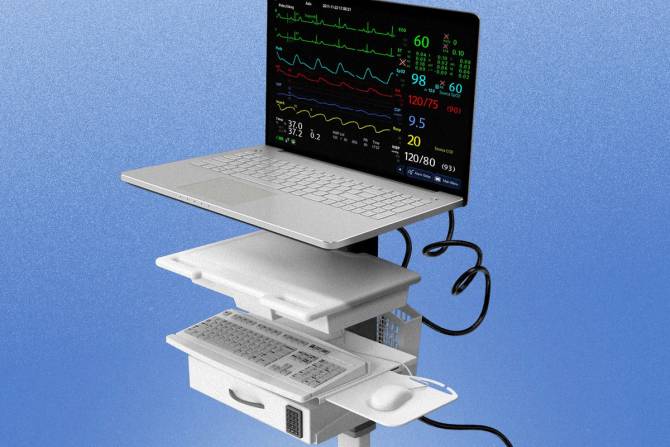
After decades of operating largely behind the counter, pharmacists are playing a more prominent role in direct clinical care. They’re working with doctors and others to determine the best medications to treat patients—including the correct doses and forms—in addition to filling prescriptions and other traditional duties.
Hospital care teams have increasingly included/added pharmacists as the field has embraced more advanced training, including the early 2000s transition to the doctor of pharmacy (PharmD) as the sole professional practice degree in the US and the expansion of pharmacist residency training.
Hospitals and health systems, meanwhile, have focused more on patient outcomes, drug utilization, and risk reduction, said David Chen, assistant VP for pharmacy leadership and planning at the American Society of Health-System Pharmacists.
That shift “is good for the patient, and it’s good for the [healthcare] organization,” he argued.
Involving pharmacists in patient care can help reduce readmissions—a key metric for Medicare and hospital accreditation—and help prevent medication-associated errors, which cost health systems over $40 billion annually and result in thousands of deaths.
The role of hospital pharmacists. Like community or retail chain pharmacists, who spend much of their workdays filling prescriptions, advising patients on medications, and—more recently—inoculating patients, pharmacists who work in clinical settings often do all of that plus perform a wide array of other functions.
They work side by side with other pharmacists, pharmacy technicians, nurses, respiratory therapists, physicians, and others—sometimes assigned to specific units or specialties—in hospitals, emergency departments, and even ambulatory facilities. Clinical pharmacists evaluate patient drug histories, make prescribing decisions, and assist in drug preparation, dispensing and administration.
Keep reading here.—SY
Do you work in healthcare or have information about the industry that we should know? Email Shannon at [email protected]. For completely confidential conversations, ask Shannon for her number on Signal.
|
|
|
It’s time to address the elephant in the room: Despite overwhelming evidence of its importance, behavioral health is one of the weakest aspects of our healthcare industry. Providers are overwhelmed, depression and anxiety go underdiagnosed, and cost of care remains unnecessarily high.
Fortunately, NeuroFlow’s got the solution. Their technology infrastructure empowers organizations to integrate behavioral healthcare into their own programs population-wide.
How? By weaving consumer engagement solutions and enterprise workflow software into a cohesive platform that meets the needs of all.
Want a peek into the clinical and financial impact of integrated care? Take a look at a case study to learn how Jefferson Health reduced ED utilization by 34% with integrated care powered by NeuroFlow’s SaaS infrastructure.
Take your integrated care programs to the next level with NeuroFlow.
|
|
Jj Gouin/Getty Images
Nearly 56% of private-sector workers signed up for high deductible health plans (HDHPs) in 2021, the highest percentage to opt for such insurance coverage since 2012, a new report suggests.
Enrollment in HDHPs—also known as “catastrophic” plans because they offer low monthly premiums but require members to pay higher upfront healthcare costs (with deductibles of at least $1,400 for individuals and $2,800 for families in 2022)—has steadily risen over the last decade after hitting a low of about 30% in 2013, according to a late January ValuePenguin analysis.
Since 2019, the report found, more than half of all US workers have signed up for HDHPs, which often appeal to younger, healthier workers who don’t use their health insurance regularly. The plans can be combined with tax-free individual health savings accounts (HSAs) or employer-sponsored health reimbursement arrangements (HRSAs) to offset out-of-pocket expenses.
Divya Sangameshwar, a ValuePenguin health insurance professional who also acts as spokesperson, noted in the report that “it’s not surprising that HDHPs are growing in popularity” given rising health insurance costs. The plans, she said, can be good options for people who are generally healthy, have HSAs, and can afford the deductible—but they’re not for everyone.
“A plan like that may force you into skipping care altogether or not filling prescriptions because you worry about going into debt to afford care,” Sangameshwar said.
The ValuePenguin analysis is based on data from the State Health Access Data Assistance Center’s State Health Compare.—SY
|
|
On Fridays, we schedule our rounds with Healthcare Brew readers. Want to be featured in an upcoming edition? Click here to introduce yourself.
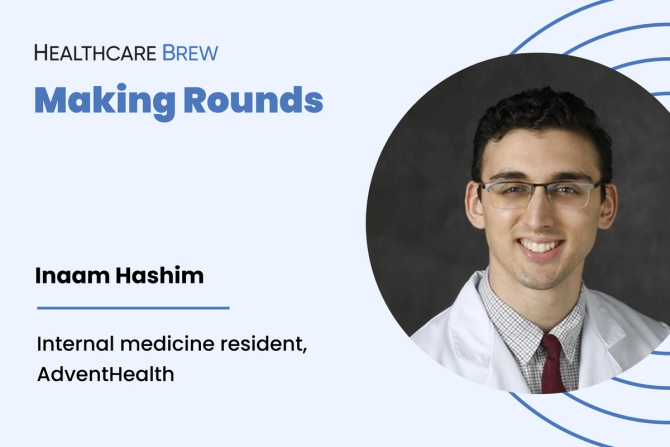
This week’s Making Rounds spotlights Inaam Hashim, a third-year internal medicine resident at AdventHealth in Orlando, Florida. Hashim spoke about steps his program has taken to improve the well-being of residents, as well as how administrative tasks, such as receiving prior authorizations for diagnostic testing, decrease the time he can spend with patients.
This interview has been lightly edited for length and clarity.
What’s the best change you’ve made or seen at a place you’ve worked?
In residency, wellness and resiliency is a huge topic, given the culture of medical training that historically has been pretty tough; you deal with burnout. Our hospital and my training program has kind of been very open-minded in terms of adopting new things to improve well-being.
We have a wellness committee—they have licensed counselors on it who also work with some other staff, and they organize multiple events for wellness. Every month we have a resident well-being day or we have dedicated time off. And this week, we have massage chairs. In the hospital, they bring people in to do yoga. They’ve had therapy pets come by. They organized an educational culinary experience nearby at the Emeril Lagasse Foundation [Kitchen House and Culinary Garden]. We can go there and learn how to cook foods that can be creative and healthy—and it’s all provided by the hospital.
What healthcare trend are you most optimistic about, and why?
We’ve already gotten into a place where medications are able to have a very, very remarkable effect on weight, and it’s really nice to see that being an option because of the dramatic effects that obesity has on patients’ lives.
Keep reading here.—KW
Do you work in healthcare or have information about the industry that we should know? Email Kristine at [email protected]. For completely confidential conversations, ask Kristine for her number on Signal.
|
|
TOGETHER WITH CURIOSITY STREAM
|
|
TV that makes you smarter. Looking for entertainment that’ll satisfy your “I wanna know more” desires? Well, call off the search. Curiosity Stream offers tons of award-winning docs on science, history, tech, nature, and travel, all updated weekly. Sign up now and use code “morningbrew” for 25% off an annual subscription.
|
|
Francis Scialabba
Today’s top healthcare reads.
Stat: Male mice tend to exhibit more erratic behavior than female mice. That fun fact has affected decades of clinical trials. (the New York Times)
Quote: “The anti-revolutionary forces want to return Oklahoma to their dream of this bygone era. They see marijuana as anathema to that dream.”—Lawrence Pasternack, a legalization advocate, on the voters who are against recreational cannabis use, despite the state’s booming medical program (Politico)
Read: The Biden administration is considering a mass vaccination strategy for the nation’s poultry amid fears that the H5N1 avian flu will sweep through the country. (the New York Times)
Putting patients first: Clinical documentation is essential, but more paperwork means less time for patient care. Nuance’s latest white paper examines how their AI-powered, voice-enabled DAX solution saves time and enhances the patient-physician experience.*
*This is sponsored advertising content.
|
|
-
About one in four parents polled in a national survey said they mislead others about their child’s vaccination or Covid-19 status.
-
Baltimore health officials reported a spike in sleep-related infant deaths.
-
Spain is the first European nation to allow menstruating people to take paid time off for severe pain and other symptoms.
-
A Washington bill on staffing ratios for nurses introduced a penalty system for hospitals that don’t comply with staffing plans implemented by internal staffing committees.
|
|
Catch up on the top Healthcare Brew stories you may have missed:
|
|
|
Written by
Shannon Young and Kristine White
Was this email forwarded to you? Sign up
here.
{if !contains(profile.lists,"Marketing Brew") || !contains(profile.lists,"CFO Brew") || !contains(profile.lists,"HR Brew") || !contains(profile.lists,"EmTech Brew") || !contains(profile.lists,"IT Brew") || !contains(profile.lists,"Retail Brew") || !contains(profile.lists,"Healthcare Brew")}
Take The Brew to work
{/if}
{if !contains(profile.lists,"Marketing Brew")}
-
Marketers:
{if !contains(profile.lists,"Marketing Brew")}
Marketing Brew
{/if}
{/if}
{if !contains(profile.lists,"CFO Brew") || !contains(profile.lists,"HR Brew")}
-
Corporate:
{if !contains(profile.lists,"CFO Brew")}
CFO Brew
{/if}
{if !contains(profile.lists,"HR Brew")}
HR Brew
{/if}
{/if}
{if !contains(profile.lists,"EmTech Brew") || !contains(profile.lists,"IT Brew")}
-
Tech:
{if !contains(profile.lists,"IT Brew")}
IT Brew
{/if}
{if !contains(profile.lists,"EmTech Brew")}
Tech Brew
{/if}
{/if}
{if !contains(profile.lists,"Retail Brew")}
-
Retailers:
Retail Brew
{/if}
{if !contains(profile.lists,"Healthcare Brew")}
-
Healthcare:
Healthcare Brew
{/if}
{if !contains(profile.lists,"Daily Business") || !contains(profile.lists,"Money Scoop") || !contains(profile.lists,"Money With Katie")}
Get smarter in just 5 minutes
{/if}
{if !contains(profile.lists,"Daily Business")}
-
Business News:
Morning Brew
{/if}
{if !contains(profile.lists,"Money Scoop") || !contains(profile.lists,"Money With Katie") || !contains(profile.lists,"Raise")}
-
Money & Career:
{if !contains(profile.lists,"Money Scoop")}
Money Scoop
{/if}
{if !contains(profile.lists,"Money With Katie")}
Money With Katie
{/if}
{if !contains(profile.lists,"Raise")}
Raise
{/if}
{/if}
Business education without the BS
Interested in podcasts?
|
ADVERTISE
//
CAREERS
//
SHOP
//
FAQ
Update your email preferences or unsubscribe
here.
View our privacy policy
here.
Copyright ©
2023
Morning Brew. All rights reserved.
22 W 19th St, 4th Floor, New York, NY 10011
|
|