It’s Monday and World Spine Day! If you threw your back out raking leaves over the weekend, you’re not alone: Lower back pain affects more than 600 million people worldwide (and that number is expected to pass 800 million by 2050), according to the World Health Organization. Don’t want to become a statistic? Stay active, stand up straight, and yes, stretch before exercising.
In today’s edition:
 ‘Medtail’ on the rise ‘Medtail’ on the rise
🩸 Innovative blood test
 Staffing trends Staffing trends
—Shannon Young, Kristine White, Courtney Vinopal
|
|
Wirestock/Getty Images
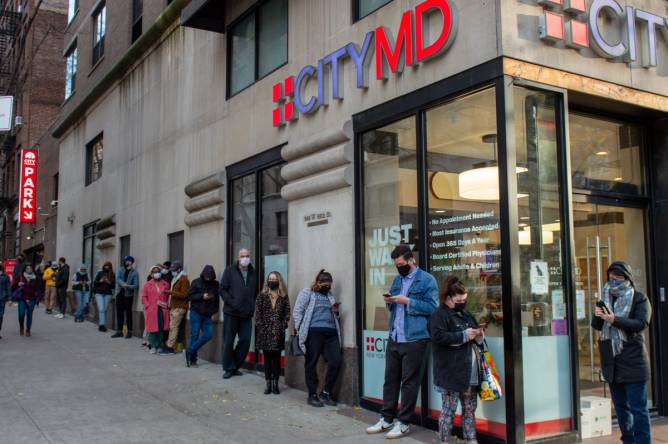
Spirit Halloween executives aren’t the only ones scouting out shuttered department stores this fall: Health system leaders are also eyeing up empty retail and office spaces to expand outpatient offerings and reach new communities.
While it may seem weird for patients go under the knife at a location that once sold knives, Jim Crispino, the healthcare leader at design firm Gensler, told Healthcare Brew that the “medtail” phenomenon—a trend in which healthcare providers open shop in former retail spaces—makes sense both financially and operationally.
“There’s a lot of overlap in terms of how they position themselves,” he said.
Both retailers and healthcare providers “use very similar models” that focus on things like visibility, accessibility, and transportation access when determining facility locations, Crispino said.
Keep reading here.—SY
Do you work in healthcare or have information about the industry that we should know? Email Shannon at [email protected]. For confidential conversations, ask Shannon for her number on Signal.
|
|
Healthcare doesn’t look like it used to. Thanks to the last few decades of medical and tech innovation, it’s better and more effective than ever.
Innovation has transformed the banking industry, too. Get the support you need to keep your organization growing with HSBC Innovation Banking.
HSBC’s dedicated tech, life science, and healthcare experts are the best in the biz. And with its extensive, interconnected global network of investors and industry pros, your organization can remain agile as it grows.
No matter where your business is in the growth process, HSBC helps you get the knowledge and solutions you need, at the right time. So your team can get back to what it does best: working toward the next life-changing breakthrough.
Get started.
|
|
Kinga Krzeminska/Getty Images
A new blood test may help clinicians screen patients for the most common and lethal type of ovarian cancer—high-grade serous ovarian carcinoma, or HGSOC—and help inform the best course of treatment.
Researchers at the University of Southern California (USC) have developed a blood test that can determine whether a pelvic mass is benign or cancerous—an intervention that can eliminate the need for surgery if biopsy isn’t possible. The test, dubbed OvaPrint, may be more reliable than existing tests for HGSOC when it’s early in its growth and easiest to treat, according to the study published on October 9.
“The test has the potential to improve treatment, because the surgical approach to removing a pelvic mass differs depending on whether it’s benign or not,” Bodour Salhia, the study’s coauthor and coleader of the USC Norris Comprehensive Cancer Center’s genomic and epigenomic regulation research program, said in a statement. “Right now, doctors essentially have to take their best guess.”
Keep reading here.—KW
Do you work in healthcare or have information about the industry that we should know? Email Kristine at [email protected]. For confidential conversations, ask Kristine for her number on Signal.
|
|
Moyo Studio/Getty Images
Human resources (HR) leaders in healthcare convened in Austin, Texas, in early October to discuss some of the biggest challenges their departments are facing. The conference, which was hosted by Worldwide Business Research, fell on the same week that more than 75,000 workers with health system Kaiser Permanente went on strike, citing concerns about staffing shortages and low wages.
Ongoing staffing challenges were top of mind for conference attendees, too. Shortages are particularly acute in areas like nursing: About 100,000 registered nurses quit during the pandemic, and another 800,000 plan to leave the workforce by 2027 due to stress, burnout, or retirement, according to one analysis.
Some HR leaders are prioritizing temporary or flex options and even gig work to fill these labor gaps. We’ve highlighted three approaches discussed at the conference.
Keep reading at HR Brew.—CV
|
|
TOGETHER WITH CURIOSITY STREAM
|
|
What should we watch? With Curiosity Stream, the possibilities are practically endless. Dig into award-winning docs, shows, and series that span science, nature, history, music, and more. New content drops every week, and plans start at under $4 a month. Tune in and learn something new today.
|
|
Francis Scialabba
Today’s top healthcare reads.
Stat: New research found that 95% of children from the Gaza Strip showed signs of mental health issues like anxiety, depression, and trauma. (Al Jazeera)
Quote: “Whenever you have something new, there may be people who run ahead with it. And there will be people who do things based on less evidence rather than more.”—Joshua Berman, the medical director for interventional psychiatry at Columbia University who helped develop its ketamine program, on misuse of the anesthetic (the New York Times)
Read: Tuberculosis cases are on the rise in New York City. (Politico)
HSBC Innovation Banking: is here so you can focus on building your businesses. With a dedicated team of life science and healthcare experts, they’re here to support companies at every stage of growth. Find out more.*
*A message from our sponsor.
|
|
ADVERTISE
//
CAREERS
//
SHOP
//
FAQ
Update your email preferences or unsubscribe
here.
View our privacy policy
here.
Copyright ©
2023
Morning Brew. All rights reserved.
22 W 19th St, 4th Floor, New York, NY 10011
|
|