Hello! Maternal mortality has been in the news lately, with reports that many issues plaguing birthing parents—namely women of color—are preventable. Though the Biden administration is incentivizing hospitals to make changes to better improve care, healthcare experts and providers told Healthcare Brew they worry that women’s health—and maternal mortality—will continue to worsen after Dobbs. Have a story to share? Tweet us @healthcarebrew.
In today’s edition:
 Maternal mortality Maternal mortality
 VR headsets VR headsets
 Hearing-aid volume Hearing-aid volume
—Michael Schroeder, Maia Anderson
|
|
Johner Images/Getty Images
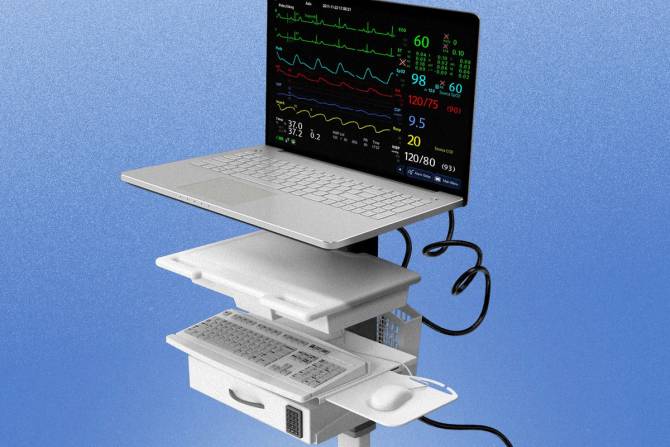
The Centers for Medicare and Medicaid Services (CMS) added a new designation to identify which hospitals are “Birthing-Friendly”—a label it will begin adding to qualifying hospitals in fall 2023.
The designation aims to reduce maternal mortality and complications in the US; maternal mortality rose by 25% in 2020, and Black women die at nearly three times the rates of white women, according to a CDC report from February. The US ranked last in maternal mortality that year compared to 10 other high-income countries, according to the Commonwealth Fund.
To earn the designation, CMS said, hospitals must participate in a statewide or national collaborative program where medical teams and public health leaders work together to improve care quality for birthing parents and babies. Hospitals that opt in qualify for an operating payment rate increase of 4.3%, a much-needed boost for hospitals struggling with profitability in the wake of the Covid-19 pandemic and inflation.
But there’s no single set of metrics that hospitals will be required to follow to earn CMS’s new designation, and any changes they make may depend on what areas need improvement. For example, hospitals could focus on reducing pregnancy complications and early births, which happen before 39 weeks, according to the CDC.
CMS’s designation—at least in its initial form—isn’t tied to outcomes. However, medical professionals said there are a variety of measures and outcomes that have been shown to make a hospital truly birthing-friendly.
When it comes to measuring maternal-care quality, one metric comes up over and over again: a hospital’s C-section rate, said Holly Loudon, chair of obstetrics, gynecology, and reproductive science at Mount Sinai West and Mount Sinai Morningside in New York City. Keep reading here.—MS
Do you work in healthcare or have information about the industry that we should know? Email [email protected] or DM @MikeSchroederIN on Twitter. For completely confidential conversations, ask Michael for his number on Signal.
|
|
|
Listening to our nurses will foster a better future in healthcare for all. To celebrate, uplift, and amplify their voices, connectRN partnered with StoryCorps—a nonprofit on a mission to preserve humanity’s stories—to give caregivers a shot at sharing their tales.
Nurses were invited to record their convos, which are archived at the Library of Congress for future generations in an effort to build a more compassionate world.
Got something in your eye? Same.
Tune in to hear about life-changing patient care experiences, working in high-stakes environments, life in the medical field, and how these superheroes in scrubs serve their patients and communities with care.
Listen here.
|
|
Smileyscope
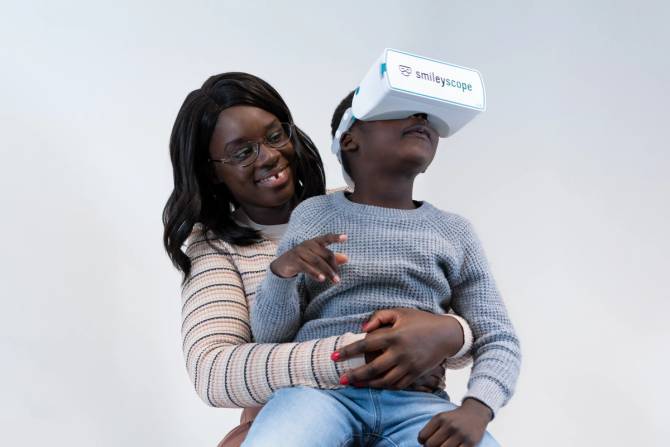
Most people don’t look forward to doctor visits, especially when it can involve being poked with needles or having to stay still in a giant metal tube for an MRI. As a pediatrician, Evelyn Chan saw children struggle with fear and anxiety during routine procedures, so she used virtual reality (VR) to solve the problem. Enter: Smileyscope.
The Smileyscope device, which looks like a View-Master (’90s kids will know), is strapped onto a patient’s head and leads them through various VR simulations—such as an underwater adventure introduced by a penguin—during common procedures like shots, infusions, and MRIs. Chan, the CEO of Smileyscope, sat down for an interview with Healthcare Brew.
What feedback have you heard from hospitals? What we find is that clinicians say that their workflow is improved. In this time, when there’s sort of a lot of staffing issues, they’re not having to pull in additional staff to help calm down a patient or hold them down if we need to or stabilize them. We found that…they’ve been able to free up staff.
What kinds of cost savings come from Smileyscope? If you can more efficiently use the MRI scanner, you can fit in an additional patient, for example. And also bedtime, because usually if you need an anesthetic, then the patient needs to be admitted for, let’s say, four to six hours. If you’re [conducting] an awake scan, they need a patient bed for probably about half that time.
Do you want Smileyscope to get acquired by a bigger digital health player or do the acquiring? We want to be the biggest and best company that we can be and deliver the most impact for our patients. So, I think that would be the latter, becoming a large player and acquiring and expanding. Keep reading here.—MA
Do you work in healthcare or have information about the industry that we should know? Email [email protected] or DM @MaiaLura on Twitter. For completely confidential conversations, ask Maia for her number on Signal.
|
|
NEXT GENERATION HEALTHCARE
|
Peakstock/Getty Images
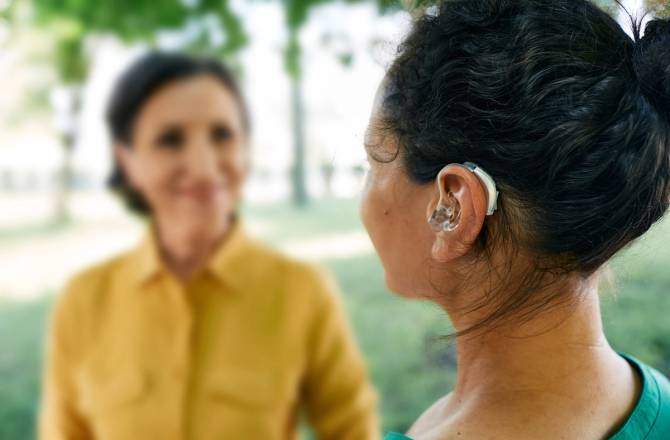
Hearing aids walk a fine line: They must amplify sound, but in a way that doesn’t further damage a person’s hearing. It’s not an exact science, either, as the FDA’s recent change on output limits for over-the-counter (OTC) hearing aids shows.
The FDA initially proposed last fall setting the decibel limit at 115 decibels, or 120 dBs for devices equipped to compress the loudest sounds.
That’s “like a jackhammer right next to your ear,” said Lindsay Creed, associate director of audiology practices at the American Speech-Language-Hearing Association (ASHA).
After some pushback—including from ASHA—the FDA revised its final rule in August that created a category for OTC hearing aids to put the output max at about 111 dBs, or 117 dBs for hearing aids with compression.
“It’s a 50% reduction in sound,” Creed said. “That’s a big reduction.”
Although sounds in the natural world can reach up to 120 dBs (and louder), Creed argued that hearing-aid users might not be able to remove the devices quickly enough or move away from the loud sound to protect their hearing. The FDA ultimately agreed the potential exposure to loud noise was outside of acceptable safety limits and, as ASHA also requested, required all OTC hearing devices to have a volume control users could adjust.—MS
|
|
|
Convos with caregivers. connectRN partnered with StoryCorps to give nurses a platform to share their stories—heartwarming, heartbreaking, and hilarious. These chats, archived in the Library of Congress for future generations, cover lessons learned and obstacles overcome—and build progress toward the future of healthcare. Wanna hear how their field has evolved? Listen here.
|
|
Francis Scialabba
Today’s top healthcare reads.
Stat: Flawed oxygen devices could have contributed to Covid-19 deaths among patients of color “several fold.” (the New York Times)
Quote: “With decades-high inflation affecting Americans everywhere, prices of certain essentials have swelled beyond some prisoners’ ability to pay.”—Patrick Irving, an incarcerated writer, on prisoners being “held hostage to price hikes” (the New York Times)
Read: Women appear to experience long-Covid symptoms more frequently than men; these five are helping researchers understand the disease. (Bloomberg)
|
|
-
Baby formula is still difficult to buy eight months after widespread shortages began.
-
J&J is betting big on heart pumps.
-
The Biden administration renewed the public health emergency for monkeypox.
-
CVS Health and Walgreens have agreed to pay ~$5 billion apiece to settle lawsuits across the US over accusations of “mishandling opioid pain drugs.”
|
|
Catch up on the top Healthcare Brew stories you may have missed:
|
|
|
Written by
Michael Schroeder and Maia Anderson
Was this email forwarded to you? Sign up
here.
WANT MORE BREW?
{if !contains(profile.lists,"Daily Business")}
Get the daily email that makes reading the news enjoyable →
{/if}
{if !contains(profile.lists,"EmTech Brew") || !contains(profile.lists,"HR Brew") || !contains(profile.lists,"Marketing Brew") || !contains(profile.lists,"Retail Brew") || !contains(profile.lists,"IT Brew") || !contains(profile.lists,"Future Social") || !contains(profile.lists,"CFO Brew")}
Industry news, with a sense of humor →
{if !contains(profile.lists,"CFO Brew")}
-
CFO Brew: your go-to source for global finance insights
{/if}
{if !contains(profile.lists,"EmTech Brew")}
-
Emerging Tech Brew: AI, crypto, space, autonomous vehicles, and more
{/if}
{if !contains(profile.lists,"Future Social")}
-
Future Social: the Brew's take on the world of social media
{/if}
{if !contains(profile.lists,"HR Brew")}
-
HR Brew: analysis of the employee-employer relationship
{/if}
{if !contains(profile.lists,"IT Brew")}
-
IT Brew: moving business forward; innovation analysis for the CTO, CIO & every IT pro in-between
{/if}
{if !contains(profile.lists,"Marketing Brew")}
-
Marketing Brew: the buzziest happenings in marketing and advertising
{/if}
{if !contains(profile.lists,"Retail Brew")}
-
Retail Brew: retail trends from DTC to "buy now, pay later"
{/if}
{/if}
{if !contains(profile.lists,"Money Scoop") || !contains(profile.lists,"The Essentials") || !contains(profile.lists,"Money With Katie")}
Tips for smarter living →
{if !contains(profile.lists,"Incrypto")}
-
Incrypto: Finally, crypto news you can understand
{/if}
{if !contains(profile.lists,"Money Scoop")}
-
Money Scoop: your personal finance upgrade
{/if}
{if !contains(profile.lists,"Money With Katie")}
-
Money With Katie: manifest your financial freedom
{/if}
{if !contains(profile.lists,"The Essentials")}
-
Sidekick: lifestyle recs from every corner of the internet
{/if}
{/if}
 Podcasts →
Business Casual,
Founder's Journal,
Imposters, and
The Money with Katie Show
Podcasts →
Business Casual,
Founder's Journal,
Imposters, and
The Money with Katie Show
 YouTube
Accelerate Your Career with our Courses →
|
ADVERTISE
//
CAREERS
//
SHOP
//
FAQ
Update your email preferences or unsubscribe
here.
View our privacy policy
here.
Copyright ©
2022
Morning Brew. All rights reserved.
22 W 19th St, 4th Floor, New York, NY 10011
|
|